
 EN
EN
What differences between natural skin care manufacturer and ordinary cosmetic factories?
Natural vs Ordinary Cosmetic Factories: Key Differences
A skincare brand founder compared two factory proposals for a calming face cream. The ordinary cosmetic factory quoted 18 days from confirmation to samples, using a stock base cream with three pre-approved botanical extracts added as marketing ingredients — the formula was 94% synthetic base, 6% plant extracts. A natural skin care manufacturer quoted 35 days, starting from raw herb selection, extraction parameter optimization, and formula rebuilding around botanical actives as the functional core — not decoration. The natural manufacturer's sample cost 40% more but delivered measurable anti-inflammatory efficacy in third-party testing, while the ordinary factory's sample provided texture and fragrance but no functional differentiation.
The difference between a natural skin care manufacturer and an ordinary cosmetic factory is not a label on the door. It runs through ingredient selection, extraction capability, formulation philosophy, and the downstream regulatory and marketing positioning the final product can support.
Ingredient Philosophy — The First Real Difference
An ordinary cosmetic factory operates from a commodity ingredient catalog. The formulator selects from standardized synthetic ingredients — emulsifiers, emollients, thickeners, preservatives, and actives sourced from chemical distributors — that are consistent, predictable, and cost-optimized for mass production. Adding a plant extract means ordering a pre-made liquid from an extract supplier and dosing it at 0.1-1.0% — enough for an ingredient-list claim but rarely at concentrations that produce functional skin effects.
A natural skin care manufacturer operates from a fundamentally different catalog. The starting point is raw botanical materials — dried herbs, roots, flowers, and fungi sourced from verified growing regions with documented species identification, harvest timing, and contaminant testing. The manufacturer selects whole-herb inputs and develops extraction parameters in-house rather than purchasing commoditized extracts. This approach requires botanical knowledge that ordinary cosmetic factories do not maintain — a formulator who understands the difference between ginseng root harvested at four years versus six years, or why centella asiatica grown at altitude produces a different triterpene profile than lowland-grown material.
This ingredient philosophy determines what claims the final product can support. A cream containing 0.2% pre-purchased ginseng extract can say "contains ginseng" on the label. A cream developed by a natural skin care manufacturer using in-house extracted ginseng at 3-5% of a standardized extract with documented ginsenoside content can claim measurable skin-revitalizing effects with supporting test data — because the active compounds are present at functional concentrations.
Extraction and Processing Capability
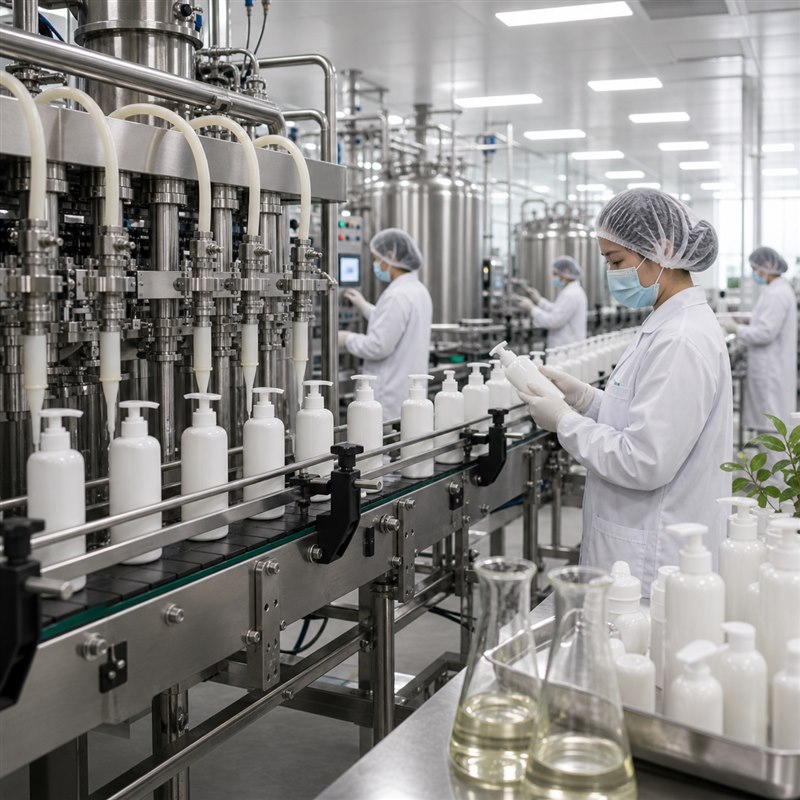
Ordinary cosmetic factories mix, heat, homogenize, and fill. Their equipment — mixing tanks, homogenizers, filling lines — is designed for these unit operations and nothing else. Extraction of botanical actives from raw plant material requires completely different equipment: supercritical CO₂ extractors operating at 200-350 bar, ultrasonic extraction baths, vacuum concentrators, spray dryers for liquid-to-powder conversion, and analytical instruments (HPLC, GC-MS) for compound identification and quantification.
A natural skin care manufacturer maintains this extraction infrastructure because formulation begins at the raw botanical, not at the pre-made extract. When a brand requests a formula centered on reishi mushroom polysaccharides, the manufacturer sources dried reishi fruiting bodies, develops a hot-water extraction protocol to isolate the beta-glucan fraction, concentrates the extract to a standardized polysaccharide content, and incorporates it into the formula at a known active concentration. An ordinary factory orders "reishi extract liquid" from a catalog and doses it at the supplier's recommended percentage — the result may feel similar on the skin but represents a qualitatively different product from a functional perspective.
Formulation Constraints
Formulating without the full toolbox of synthetic ingredients imposes genuine constraints that a natural skin care manufacturer must solve through deeper formulation expertise. Synthetic emulsifiers produce stable creams across wide temperature ranges with simple processing. Natural emulsifiers — lecithin, glyceryl stearate citrate, polyglyceryl esters — require more precise temperature control during processing and produce emulsions with narrower stability windows. The manufacturer must test multiple emulsifier combinations, optimize the homogenization parameters, and conduct accelerated stability testing (40°C/75% RH for three months) to confirm that the natural system matches synthetic stability performance.
Frequently Asked Questions
What is the main difference between a natural skin care manufacturer and a regular cosmetic factory?
A natural skin care manufacturer starts from raw botanical materials and develops in-house extraction processes to produce functional active ingredients. An ordinary factory purchases pre-made ingredients from chemical catalogs and blends them. The natural manufacturer invests in extraction equipment, botanical sourcing expertise, and natural formulation knowledge that ordinary factories do not maintain.
Can ordinary cosmetic factories make natural products by adding plant extracts?
Adding small amounts of pre-purchased plant extracts to a synthetic base formula creates a product that lists botanical ingredients but rarely delivers functional skin benefits. The extracts are typically present at 0.1-1.0% — insufficient concentration for measurable effects. Natural skin care manufacturers formulate products where botanical actives are the functional core at effective concentrations, verified by analytical testing of active compound content.
Why does natural skincare manufacturing cost more than conventional?
Raw botanical materials cost more than synthetic commodity ingredients. Extraction equipment (supercritical CO₂, ultrasonic, vacuum concentration) represents significant capital investment. Natural preservation systems require more formulation development and stability testing. The longer development timelines and lower throughput per batch compared to synthetic mass production all contribute to the cost differential.
How is quality controlled differently in natural skincare manufacturing?
Natural manufacturers control quality starting from raw material authentication — species identification, geographic origin verification, contaminant screening (pesticides, heavy metals, mycotoxins). Active compound content is quantified throughout extraction and formulation. Ordinary factories control quality at the finished product level — appearance, viscosity, pH, microbial limits — but do not verify botanical active content because they purchase pre-made extracts at unknown standardization.
What certifications distinguish a natural skin care manufacturer?
COSMOS or ECOCERT certification validates organic and natural ingredient sourcing and processing. ISO 22716 confirms GMP-compliant cosmetic manufacturing. Vegan and cruelty-free certifications verify ethical standards. CCIC factory certification provides independent production capability verification. The combination of certifications provides independently audited evidence of manufacturing practices beyond marketing claims.
Do natural skincare products have shorter shelf life than conventional products?
Properly formulated natural products using optimized natural preservation systems, appropriate packaging (airless pumps, opaque containers), and controlled water activity achieve shelf lives of 24-30 months — comparable to conventional products. The critical factor is formulation expertise, not ingredient origin. A poorly formulated synthetic product fails faster than a well-formulated natural product.