
 EN
EN
Can organic skincare manufacturer develop whitening formulas without chemical additives?
A European clean-beauty brand wanted to launch a brightening serum positioned as 100% plant-derived — no synthetic hydroquinone, no kojic acid, no chemical UV filters. Three organic skincare manufacturer candidates were evaluated. Two proposed formulas relying on stabilized vitamin C derivatives synthesized in a laboratory, which the brand's formulator rejected as inconsistent with the "no chemical additive" claim. The third manufacturer — a Guangzhou-based OEM specializing in herbal extraction — proposed a formulation centered on bearberry-derived arbutin, licorice root extract, and mulberry root extract, preserved with a plant-based antimicrobial system. The serum passed stability testing, delivered measurable brightening in a four-week consumer trial, and launched with full EU cosmetic compliance.
The question of whether an organic skincare manufacturer can develop effective whitening formulas without synthetic chemicals has a clear answer: yes — when botanical actives are selected for documented efficacy and formulated with modern extraction and stabilization techniques.
The Clean Beauty Standard — What "No Chemical Additives" Means
The term "no chemical additives" in skincare requires careful definition. Water is a chemical. Glycerin is a chemical. The distinction that matters to consumers and formulators is between synthetic chemistry — molecules created through industrial chemical reactions that do not exist in nature — and nature-derived chemistry — molecules extracted, concentrated, or gently modified from botanical sources.
An organic skincare manufacturer working to a "no synthetic additive" standard formulates with ingredients whose origin can be traced to a plant, mineral, or naturally occurring substance. The extraction process may use food-grade solvents (ethanol, glycerin, supercritical CO₂), physical separation (cold pressing, steam distillation), or enzymatic processing — but the starting material is botanical, not petrochemical. This standard is more meaningful than an undefined "natural" claim and more achievable than a strict "no processing" position that would make modern skincare formulation impossible.
Botanical Brighteners That Actually Work
The Plant-Based Brightening Trio
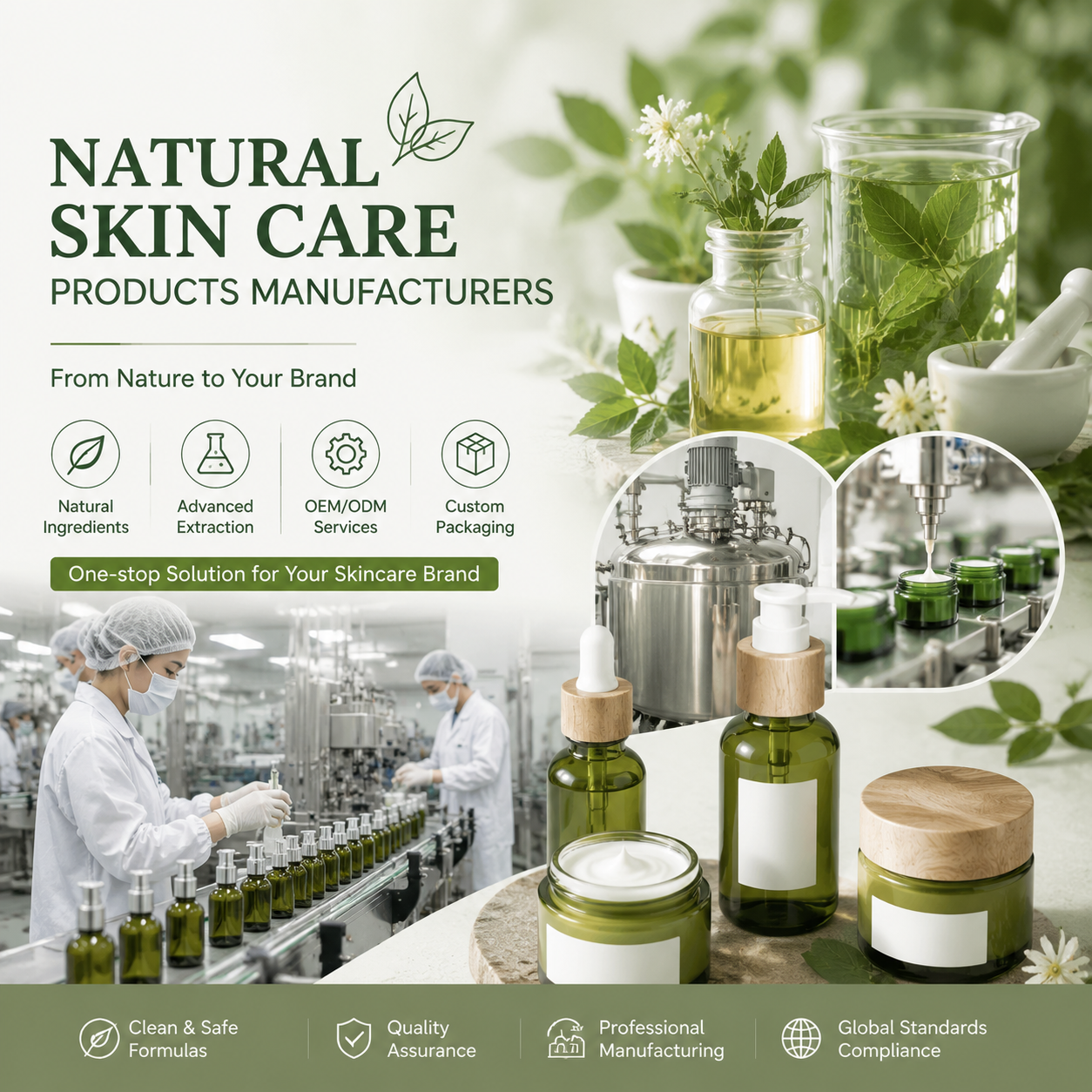
Three botanical ingredients form the core of plant-derived brightening formulations from a capable organic skincare manufacturer. Bearberry leaf extract (Arctostaphylos uva-ursi) is a natural source of arbutin — a glycosylated hydroquinone that inhibits tyrosinase, the enzyme responsible for melanin production, without the cytotoxicity risks associated with free hydroquinone. Arbutin's molecular structure — glucose bound to hydroquinone — allows controlled release at the melanocyte, providing brightening action without the irritation and cytotoxicity of its synthetic counterpart.
Licorice root extract (Glycyrrhiza glabra) contains glabridin, which inhibits tyrosinase activity through a different mechanism than arbutin — it suppresses the enzyme's catalytic function rather than competing for its active site. This complementary action broadens the spectrum of melanin-production inhibition. Licorice also delivers anti-inflammatory flavonoids that calm the post-inflammatory hyperpigmentation common in acne-prone and sensitive skin types.
Mulberry root extract (Morus alba) contributes mulberroside F, another tyrosinase inhibitor with documented efficacy at concentrations as low as 0.1-0.5%. The combination of multiple botanical actives targeting melanin production through different pathways produces additive brightening effects without the concentration-dependent irritation that limits single-agent synthetic approaches.
How Extraction Technology Determines Potency
The difference between a crude herb powder suspended in cream and a clinically effective botanical brightening product lies in extraction. An experienced organic skincare manufacturer uses modern extraction technologies — supercritical CO₂ extraction, ultrasonic-assisted extraction, or vacuum concentration — to isolate and concentrate the active compounds while removing inert plant material, chlorophyll, and waxes that contribute nothing to efficacy but can destabilize the formula or cause an unpleasant color and odor.
Formulating for Stability Without Synthetics
The most difficult challenge in botanical brightening is preservation. Plant extracts are nutrient-rich media that support microbial growth. An organic skincare manufacturer without synthetic preservatives must create a hostile environment for microorganisms through formulation design — pH control at 4.5-5.5 using naturally derived acids, water activity reduction through humectant systems, and multifunctional botanical ingredients (such as fermented radish root and coconut-derived caprylyl glycol) that serve both as skin conditioners and antimicrobial agents. This formulation approach requires more development time, more stability testing, and more ingredient knowledge than simply adding parabens — but it delivers a product that satisfies the "no chemical preservative" claim.
Frequently Asked Questions
Can organic brightening products really match the efficacy of synthetic ones?
Yes, when formulated with documented botanical actives at effective concentrations. Arbutin at 2-4%, combined with licorice and mulberry extracts, delivers measurable brightening comparable to low-concentration synthetic agents. Botanical formulations work more gradually — 4-8 weeks for visible results versus 2-4 weeks — but with lower irritation risk and a broader skin-comfort profile suitable for sensitive skin.
What botanical ingredients provide actual whitening effects?
Bearberry (natural arbutin), licorice root (glabridin), mulberry root (mulberroside F), peony root, and vitamin C from acerola cherry all demonstrate tyrosinase inhibition in controlled studies. Their efficacy depends on extraction quality, concentration in the final formula, and formulation stability — the same botanical ingredient from two different suppliers can produce dramatically different results.
How does an organic skincare manufacturer preserve products without parabens?
Multifunctional preservation systems combine pH-controlled environments, water activity management, and naturally derived antimicrobial ingredients — fermented radish root filtrate, coconut-derived glyceryl caprylate, and sodium levulinate. These systems require more formulation expertise than synthetic preservatives but satisfy clean-beauty certification requirements and consumer preference for recognizable ingredient names.
What is the difference between arbutin and synthetic hydroquinone?
Hydroquinone is a potent synthetic melanin inhibitor associated with cytotoxicity, ochronosis risk, and regulatory restrictions in multiple markets. Arbutin is a naturally occurring glycoside that releases hydroquinone gradually through enzymatic cleavage in the skin, providing brightening with substantially reduced irritation and safety concerns — this is why botanical arbutin is permitted in markets where free hydroquinone is restricted or banned.
How long does botanical whitening skincare take to show results?
Visible brightening typically appears after 4-8 weeks of consistent twice-daily use. Botanical actives work through gradual melanin-production inhibition rather than the rapid melanin dispersion or exfoliation mechanisms of synthetic alternatives. The slower onset is offset by superior tolerability for daily use and compatibility with sensitive and reactive skin types.
What certifications should an organic skincare manufacturer hold for whitening products?
COSMOS or ECOCERT certification validates organic ingredient sourcing and processing standards. ISO 22716 (GMP for cosmetics) confirms manufacturing quality systems. Vegan and cruelty-free certifications (Leaping Bunny, Vegan Society) support the ethical positioning that clean-beauty consumers expect. Country-specific organic certifications (USDA Organic, COSMOS Organic) may apply depending on the target market's regulatory framework.