 EN
EN
What MOQ Standards Do Most Skincare Manufacturers Set for New Brands?
Minimum order quantity is one of the first practical barriers every new skincare brand runs into. You have a formula direction, a product concept, and a target market. Then you contact a skincare manufacturer and find out their minimum is 3,000 units per SKU—before you have sold a single item. The question most founders ask at this point is: is that normal? And the honest answer is: it depends on the manufacturer type, the product format, and what kind of deal you are actually negotiating.
This article walks through the questions that tend to surface first, because the topic of custom skincare MOQ is more layered than a single number can capture. Whether you are approaching a factory for the first time or revisiting your assumptions about what a reasonable skincare factory minimum order looks like, understanding how manufacturers set these thresholds helps you ask better questions from the start.
What Is MOQ and Why Do Skincare Manufacturers Set It?
MOQ—Minimum Order Quantity—is the smallest production run a manufacturer will accept in a single batch. The reason it exists is not arbitrary. A skincare manufacturer has real setup costs attached to every production run: filling line configuration, raw material minimum purchases, mixing time, in-process quality checks, and packaging procurement. When a batch is too small, those fixed costs cannot be distributed across enough units to make the run financially viable for either party.
It is not a pattern unique to skincare. But the economics matter more here than in many other manufacturing categories because cosmetic formulations often involve specialty botanical actives, precision pH management, and multiple stability checkpoints. Each of those adds to the cost structure that drives the minimum floor.
Understanding this helps you have a more productive supplier conversation. A skincare manufacturer who explains their MOQ in terms of batch economics is usually more reliable than one who gives you a number with no rationale attached.
What Are the Typical MOQ Ranges for Skincare Products?
Ranges vary significantly across manufacturer types and product categories. As a rough orientation for new brands researching their first skincare factory minimum order:
- Full-scale OEM manufacturers — typically 3,000 to 10,000+ units per SKU. These factories are optimized for volume production and do not adjust their line economics easily for smaller runs. As a skincare manufacturer category, they serve established brands with predictable volume.
- Mid-tier OEM manufacturers — commonly 1,000 to 3,000 units. This is the range where custom formulation, sampling, and trial batches are more realistic for brands at an early stage.
- Low-MOQ or flexible manufacturers — anywhere from 250 to 1,000 units depending on product type. Facial serums and oils tend to have lower floors (250–500 units); moisturizers and creams usually require 500–1,000 units at a minimum.
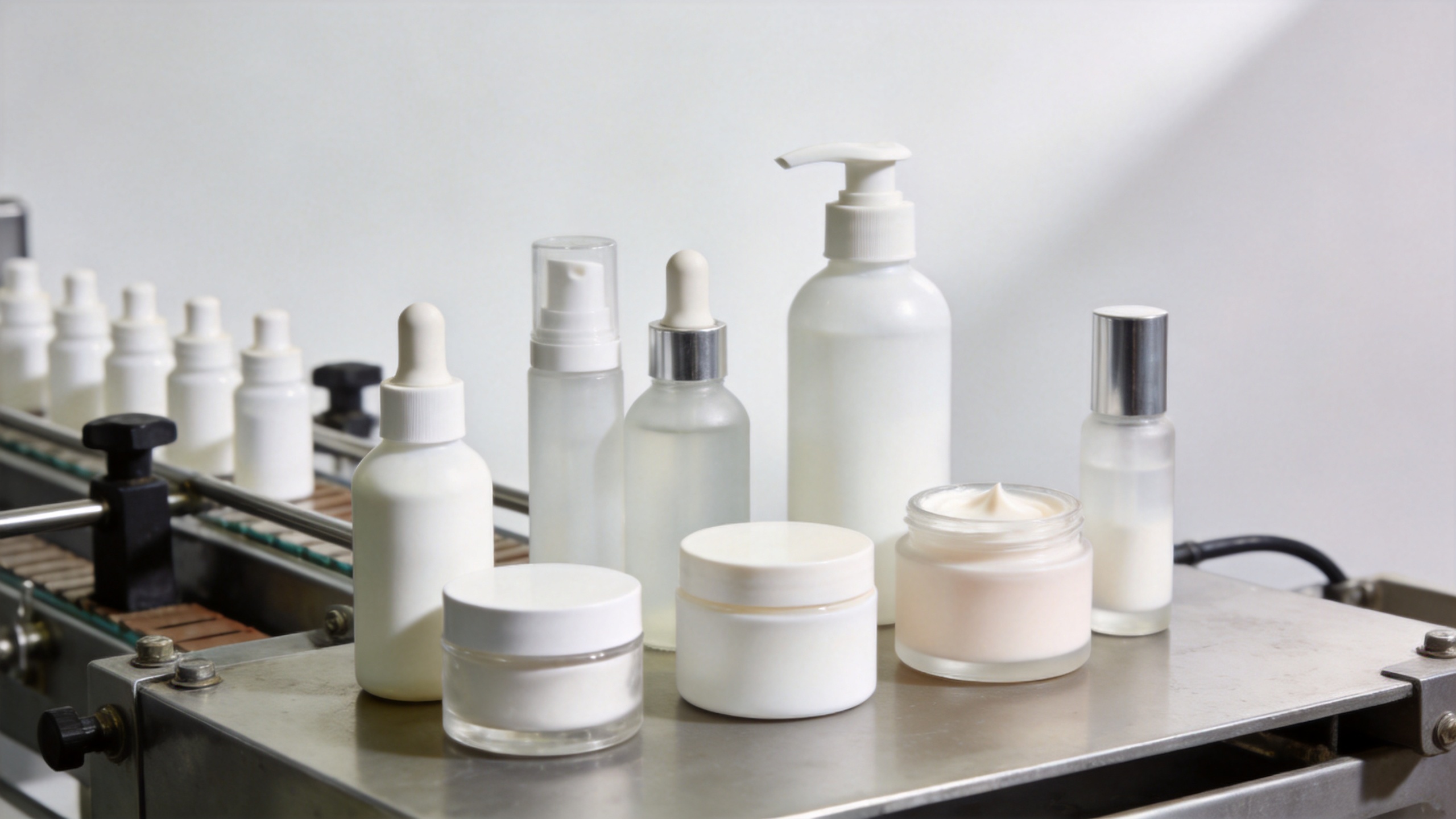
These ranges are not fixed rules. They reflect the typical position of different factory types, and individual manufacturers will vary based on their current production schedule, the complexity of your formula, and whether they already carry similar base formulations. Discussing custom skincare MOQ expectations upfront saves time on both sides of the initial inquiry.
How Does Manufacturer Type Affect MOQ?
The OEM versus ODM distinction matters more here than most new brands expect. With ODM—where the manufacturer provides a pre-developed formula that you private-label—MOQs are often lower, commonly 300 to 1,000 units. The reason is that the development cost has already been absorbed by previous clients who ordered the same base. The manufacturer's setup investment is already amortized.
With custom OEM—where you are commissioning a new formula built to your specifications—the MOQ reflects both development investment and production economics. Custom formulation work, stability testing, and compatibility validation all need to be recovered somewhere. That is why custom MOQs tend to start higher, often 1,000 to 3,000 units at minimum even for a relatively straightforward product.
So here is the thing about custom skincare MOQ: it sounds like a production variable, but it is really a question about what you are actually buying. White-label speed-to-market, or a defensible formula that belongs to your brand. That distinction changes the math entirely. Before committing to a specific skincare factory minimum order agreement, it is worth clarifying which model you are engaging with.
What Does "Low MOQ" Actually Cost You?
The MOQ quote looks manageable until you add packaging tooling fees, custom label printing minimums, and shipping. First-time buyers often underestimate how much of their launch budget gets committed before a single unit sells. A skincare factory minimum order of 500 units sounds accessible at $5 per unit until you realize the custom packaging supplier requires 2,000-unit minimums on printed cartons—and suddenly your accessible production run is waiting on packaging that will not be ready for another six weeks.
Low-MOQ manufacturing can allow brands to start with $10,000–$15,000 in initial product investment rather than committing $60,000 or more to inventory before the first sale. But that comparison assumes everything else is aligned—packaging, labeling, lead times, and fill quantities. In practice, the lowest-MOQ skincare manufacturer is not necessarily the one that makes your total launch economics work.
Is a Lower MOQ Necessarily Better for a New Brand?
It seems like a lower MOQ is invariably the better choice for a new brand. In practice, manufacturers with very low minimums often lack the formulation customization depth or stability documentation that a brand needs to grow past its first iteration—and that often changes which manufacturer type actually makes sense at this stage.
Manufacturers who offer low custom skincare MOQ flexibility typically price that flexibility into the unit cost. The question is whether your current sell-through confidence justifies the premium—or whether it makes more sense to commit to a larger run and reduce per-unit cost. If you are entering a proven category with validated demand, a 2,000-unit first run with a more capable factory is often a better decision than 300 units with a low-MOQ supplier who cannot support scale when you need it.
There is a real case for going with a skincare manufacturer that accommodates smaller initial batches—scale often becomes important after market validation, not before it. That said, a brand in its early stages may get better formulation attention and more documentation support from a mid-sized manufacturer with appropriate capacity, compared to a factory optimized for micro-batches that does not invest in the quality infrastructure you will eventually need.
How Should New Brands Evaluate MOQ as Part of Manufacturer Selection?
Before taking any MOQ figure at face value, a few questions are worth putting to the skincare manufacturer you are evaluating:
- Is the MOQ for production units or finished goods? Some manufacturers quote in kilograms of bulk formula rather than finished units, which changes the effective minimum significantly.
- Does the MOQ change between the sample phase and the production run? Some factories set a lower minimum for validation batches and require larger commitments for subsequent orders.
- What is driving the minimum—filling line economics, packaging procurement, or formula batch size? Understanding the bottleneck helps you figure out whether there is room to negotiate or whether the skincare factory minimum order floor is genuinely fixed.
- Can the manufacturer provide stability data and export documentation at that volume? A flexible MOQ without the supporting quality infrastructure creates downstream compliance risk for international markets.
Manufacturers with genuine small-batch flexibility—backed by real formulation capability, GMP-aligned production, and export-ready documentation—are a specific type of partner, not the same as factories that simply accept smaller orders because they cannot fill their line otherwise. The difference matters when you are building a brand rather than testing a concept.
A Starting Point for MOQ Conversations
If you are evaluating a skincare manufacturer and their MOQ seems high relative to your launch plan, the most useful thing you can do is ask them to walk you through what is driving the minimum. A transparent answer tells you about the factory's quality culture and communication style as much as it tells you about the MOQ itself. A factory that explains batch economics in detail is usually also the one that will communicate clearly when a production issue arises.
The right custom skincare MOQ for a new brand is not the lowest number you can find. It is the one that fits your launch economics, supports your formulation requirements, and comes from a skincare manufacturer who can grow with you when your volumes increase.