 EN
EN
Cost Breakdown: Real 2026 Pricing from a Chinese Cosmetic Contract Manufacturer
As a contract manufacturing specialist with hands-on experience in skincare and intimate care production for international brands, I evaluate pricing from the perspective of real cost drivers, not just the number on an initial quote. The most common question I hear from brand owners considering a Chinese cosmetic contract manufacturer for the first time is some version of: "How much does this actually cost?" The answer is that the cost breakdown is more layered than any single unit price suggests.

Why the Pricing Structure Is More Than a Per-Unit Rate
Early on, most brands focus on finding the most affordable OEM option. What shifts things is realizing that the lowest quote rarely accounts for reformulation rounds, hidden testing fees, or packaging tooling. Once those costs surface mid-project, the initial savings disappear. A realistic cost breakdown from a cosmetic contract manufacturer has five distinct components, and understanding each one is what separates a workable launch budget from an expensive surprise.
The Five Core Cost Components in 2026
1. Formulation and Development Fee
If you are bringing a custom formula, or asking the manufacturer to develop one for you, expect a formulation fee before production begins. For standard skincare bases with targeted adjustments, this typically runs $300–$1,000 per formula from a Chinese manufacturer in 2026. For more complex briefs including intimate care formulations, spray-format products, or herb-active concentration work, the range extends to $500–$2,000 depending on required testing cycles and ingredient sourcing.
Some manufacturers waive this fee above certain MOQ thresholds. If they do, verify whether the development cost has been folded into the unit price instead. It rarely disappears entirely.
2. Unit Manufacturing Cost
For most standard cosmetic contract manufacturer output from China, per-unit cost in 2026 falls between $0.50 and $6.00, depending on format, ingredient complexity, and order volume. Cream and lotion formats for skincare sit toward the lower end. Serums with active botanical ingredients, gel formulations for intimate care, and spray-format products typically run higher.
For brands developing herbal or TCM-inspired formulas, manufacturers based in Guangdong province may offer more formulation complexity per unit than manufacturers sourcing the same ingredients through international intermediaries. This reflects the real cost efficiency that comes from proximity to China's primary botanical raw material supply chains. Tongkang's Guangzhou facility is one example of how regional raw material access translates into a meaningful cost structure advantage for herb-active formulations.
3. Sample Fees
Before committing to a production run, you will go through one or more sample rounds. A single round typically costs $200–$500 in labor and material, plus international courier shipping ($50–$150 via DHL or FedEx). Budget for at least two rounds, and three if the brief involves sensory-sensitive formulas like intimate care or spray-format products.
Rushing the formulation brief to reduce sample rounds tends to cost more in the end. A misunderstood texture specification or fragrance direction becomes an additional revision cycle, not a shortcut. Clearly specifying target skin feel, active concentration, and application context generally reduces the total development timeline.
4. Testing and Certification
Stability testing, microbial challenge testing, and finished-goods safety documentation are not optional for brands targeting export markets. The typical per-SKU testing cost structure from a qualified cosmetic contract manufacturer in China includes:
- Stability testing (accelerated and real-time): $300–$800
- Microbial testing: $150–$400
- Heavy metal testing: $200–$500
- Export documentation (quality certificates, batch records): typically bundled into the production order cost
If your target market is the US and your formula includes any botanical actives above standard concentration, FDA MoCRA compliance documentation adds another $500–$2,000 to the per-product cost. Manufacturers holding internationally recognized certifications such as CCIC certification provide documentation infrastructure that streamlines customs clearance for US and international shipments.
5. Packaging
Standard stock packaging from Chinese cosmetic suppliers runs $0.30–$2.00 per unit for airless pumps, glass bottles, and tubes. Custom mold tooling carries a one-time cost of $2,000–$8,000. Labels add $0.10–$0.50 per unit. Outer cartons add $0.20–$1.00.
The initial MOQ quote looks manageable until you factor in packaging tooling, custom label printing minimums, and international freight. First-time buyers consistently underestimate how much of the launch budget commits before a single unit sells.
The MOQ Dynamics That Affect Your Total Cost
Here is the thing about MOQ flexibility from a Chinese cosmetic contract manufacturer: manufacturers who offer low minimums tend to price that flexibility into the unit cost. The question is whether your current confidence in sell-through justifies the per-unit premium, or whether committing to a larger initial run and reducing the unit cost by 15–30% makes more sense.
For Chinese manufacturers in 2026, MOQs typically start at 500 units per SKU for standard formulas. Some manufacturers accommodate smaller pilot batches of 200–300 units to verify real-production quality before committing to full volume. This is worth asking about, particularly for first-time orders or new formula types. If you are evaluating a China-based cosmetic contract manufacturer for a herbal or intimate care product line, confirming MOQ flexibility and pilot batch availability upfront is worth building into your supplier evaluation.
Realistic Total Investment Scenarios for 2026
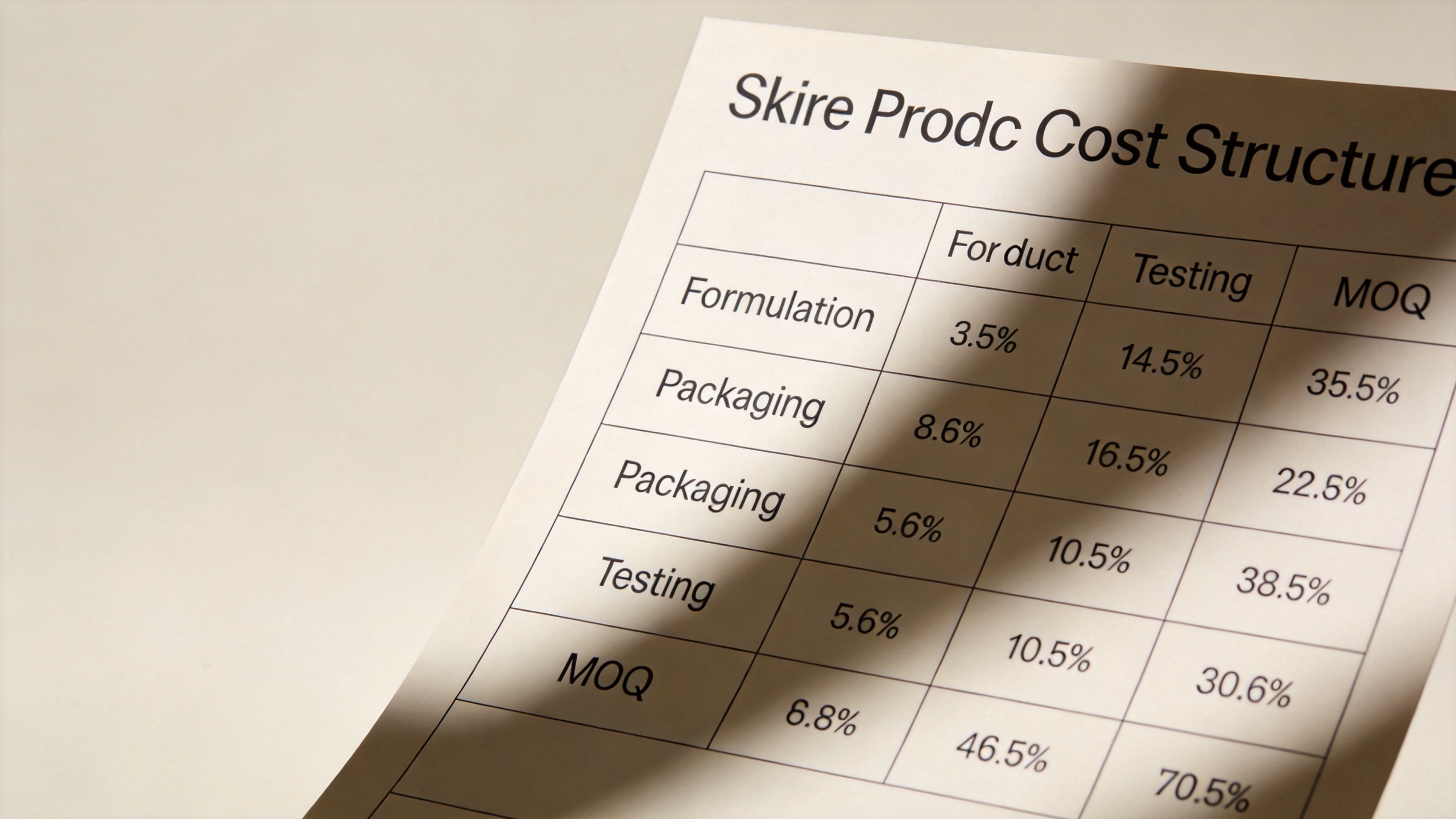
Here is a representative cost breakdown for a single herbal skincare SKU (500 units, stock packaging, US export target):
| Cost Component | Estimated Range |
|---|---|
| Formulation / development fee | $300–$800 |
| Sample rounds (2 rounds) | $400–$800 |
| Unit manufacturing (500 units × $1.50–$3.00) | $750–$1,500 |
| Stock packaging | $200–$600 |
| Stability + microbial testing | $500–$1,200 |
| US FDA compliance documentation | $500–$1,500 |
| Total (estimated, single SKU) | $2,650–$6,400 |
For a 3-product herbal skincare brand launch from a China-based manufacturer, realistic total investment runs $8,000–$15,000 covering formulation, two sample rounds per SKU, stability testing, stock packaging, and production at 500 units per SKU. Premium botanical formulas with custom packaging and additional certification requirements typically fall into the $15,000–$35,000 range for a five-product collection.
The Pricing Structure Questions to Ask Any Manufacturer
Before selecting a cosmetic contract manufacturer, request an itemized breakdown covering each of the following: development fees versus unit manufacturing cost; packaging cost per unit and tooling charges if applicable; testing costs per product type; export documentation fees; and payment terms by production milestone.
The unit price on the initial quote rarely reflects the full cost. Understanding the complete pricing structure from formulation development to first shipment is what allows you to build a realistic launch budget rather than one that runs short before the product reaches the shelf.
Whether your priority is a competitive per-unit cost for a high-volume skincare range or specialized formulation capability for herbal or intimate care products, the right cosmetic contract manufacturer for your situation will be the one who can walk you through this cost breakdown transparently before you sign anything.